Showing posts with label Portugal. Show all posts

July 6, 2010

6/29: Japan v Paraguay, Spain v Portugal

Our tapas tasting menu takes you across the world from Asia to Latin America, culminating in the flavors of Iberia.
A taste of Paraguay
Paraguayans are consummate snackers. Seldom settling down for a meal, they munch endlessly on chipa, a sort of indigenous spin on the croissant, which is hawked by chipa barreros that ride bikes touting fresh chip for sale throughout every neighborhood. While it comes in varying shapes and sizes, the medialuna, or crescent, is the most common, hence the comparison to a croissant. If chipa intrigues you, Anna Elise to Paraguay is a lovely little blog about an exchange student's experience in Paraguay and has much to say of the local culinary customs.
Chipa
1 1/2 C yuca harina
1 2/3 C  corn flour (much finer than corn meal)
3 eggs
1 1/2 C grated strong cheese such as Cotija or Parmesan
4 T lard
1/2 cup milk

Preheat the oven to 425F. Mix the harina and cornmeal, cut in the lard with a fork and whisk in the eggs. Stir until fairly uniform then add the cheese and milk, kneading until smooth. Salt to taste. Shape. Bake ~15 min on a baking stone until golden and crisp. *Also known as tapioca starch/almidon de yuca/manioc starch, it’s widely available online or in Latin American markets.  It should not be confused with manioc flour used for farofa which is darker and has a grainier texture.


A taste of Japan, via Portugal
Unbeknownst to many, the popular Japanese tempura preparation is of Portuguese origin, brought to Japan in the 16th C by missionaries. The batter uses cold water, soft flour and some leveaning to keep it fluffy and light. Traditionally mixed with chopsticks for only a few seconds, the mixture is lumpy, allowing for crisp balls of batter to form on the food. Thin slices of vegetables or seafood are dipped in the batter, then deep-fried in hot oil, traditionally sesame oil. Traditional tempura includes seafood and vegetables, but we honor seafaring, grilled sardine obsessed Portugal.

Sardines Tempura
1/2 lb fresh sardine fillets
1 1/4 C AP flour + more for the initial coating
1 tsp baking powder
2/3 C ice cold sparkling water
sea salt, and freshly ground black pepper

Coat the sardines in flour, salt and pepper. Heat a sauce pan of sesame oil, or canola oil to 350F. Whisk together the 1 1/4 C flour with baking powder, water and a sprinkling of salt and pepper. Keep the batter over ice as you coat the sardines, shaking off the excess, and fry ~5 min. until golden. Drain excess oil, sprinkle with fleur de sel and serve hot.


A taste of Iberia - bom apetite y buen procecho!
Gambas are a ubiquitous staple of taverna cuisine on both sides of the Iberian. In Spain they are prepared in a simple marinade of fresh garlic, lemon and oil, while in Portugal this preparation includes the introduction of a piri-piri pepper and Madeira rather than sherry. Both variations are cooked and served in earthenware cazuelas, but you can use any skillet. Our version includes the piri-piri, but the dish is divine even without it.
Gambas Al Ajillo/Camarões Piri-Piri
6 T Spanish Olive Oil
6 cloves garlic, sliced
1 piri-piri pepper, sliced lengthwise in two
1lb medium shrimp
Juice of 1 lemon

In a cazuela or cast iron skillet, heat the oil, garlic, and pepper.  When the garlic just begins to turn golden, add the shrimp and cook on high ~3 minutes.  Add the lemon juice and sprinkle with salt and parsley.  Serve immediately, preferably in the same dish.


Many of my favorite tapas recipes are inspired by my favorite Spanish restaurant state-side, La boca in Santa Fe, NM. I had a crush on the chef there as a teenager just introduced to Spanish haute cuisine at El Farol and I followed him diligently when he finally opened up his own place a few years ago.  For a delightful tapas tasting experience in Houston without all the cooking, try Oporto. Their menu offers a unique blend of many of the Spanish and Portuguese traditional dishes that you see here.

Almendras con Pimentón de la Vera 

This simple preparation of marcona almonds makes for the ultimate bar snack. Pan fry in olive oil and season with fleur de sel and Spanish smoked paprika. I use an Applewood Smoked salt to enhance the smokey sweetness of the paprika.

The bruschetta with mushrooms, fried egg, truffle oil, reggianito 

One of my current favorites and easy to prepare. I sauté a selection of wild mushrooms, such as trumpet, shitake and hen of the woods, in Spanish olive oil over low heat until soft. Then I add a dash of whatever red wine I'm drinking. When nearly all the liquid is absorbed, I remove from heat, grate reggianito on top, then distribute across slices of baguette. My boyfriend, chief egg fryer of the household, takes care of that, unless we are poaching, which is my job. I then carefully place the egg atop arranged bruschetta, season with fleur de sel and  sprinkle with white truffle oil. If I'm feeling indulgent, I'll use black truffle powder instead.
As with true Spanish cooking, strict recipes are not at the heart and soul of these dishes - rather, be inspired, playful, and use the ingredients that speak to you to create your desired flavors.
Our recipe for Ajo Blanco, often refered to as "white gazpacho," is inspired by a recipe from José Andrés, who serves this dish at Jaleo in Washington DC with lump crap and garnished with green grapes.
Ajo Blanco
1 C blanched almonds
4 garlic cloves
2 C water
3 slices pan de campagne, crusts removed
4 T  freshly pressed white grape juice
Splash of dry sherry
1 C  Spanish olive oil
Combine almonds, garlic and water in saucepan. Bring to a boil; cool slightly. Purée until frothy, season to taste and and refrigerate. Serve cold and garnish with grapes.


HEY! We've seen that cuisine before! Cook the foods of today's competing countries using other recipes: Regardless of what happens during Japan v Paraguay, the game and cuisine are sure to take backstage to the Iberian feast we have planned for Spain v Portugal. You're likely to have noticed by now through my single inclusion of Japan in a dipping sauce that this is a cuisine that has never quite been able to interest me. Paraguay, on the other hand, with its hearty reflections of Argentina and indigenous cultures, I find enticing. Dishes such as Sopa Paragauay, with the slight deviation of adding my homegrown green chile, and the fried deliciousness of the Milanesa make this landlocked Latin American country the clear winner in this match. My bets are on them for the game as well.


Portugal, the land of my beloved porto; the country that gave birth to Feijoada and spiced up Mediterranean dishes with Piri Piri has much to be proud of, but will forever take backstage to its larger neighbor to the east. Spain, more beloved to me even than porto for its Rioja, brings Manchego and Chorizo as well as Peras al Vino to the table. While they may win on the basis of these dishes alone, traditional Paella clearly puts them on top, so much so that we devoted an entire post to discussing their cuisine.


Prefer to eat out instead? Our Dining Guide tells you where and why.

June 28, 2010

Elimination Round

On to the Round of 16! Stepping into the elimination stage, we take a look at the foods of those countries that have made the cut:


Uruguay found its way on the menu several times since opening day, twice fused with France in Dulce de Leche Crème Brulée and Duck Confi Ravioli. They'll face South Korea on Saturday, a country we've seen in spicy and distinctly Asian short ribs.


Later on Saturday, the US faces Ghana in an unexpected match. Ghana may compete on the pitch, but in the World Cup of Food, USA is a clear winner with Bacon Brownie Cupcakes and Texas Peach Pie over Ghana's Jollof rice. However, a Ghanian spin on German Black Forest Cake may be one of the 2010 WCFC's crowning achievements.

Later on in the weekend, England will face a formidable opponent in Germany in what is sure to be a violent match between the two rivals. While it may be World War on the pitch, Käsespätzle, or German mac 'n cheese, made a great addition to our English Ploughman's Lunch, albeit with an Algerian twist.
Earl Grey Ice Cream, however, would be an unlikely topping for our bananas Ghana take on German Black Forest Cake.

Argentina versus Mexico presents a great opportunity for exploring two complimentary, but unique and exciting cuisines. While Argentina will always hold a special place in our hearts for blessing us with Chimichurri and Malbec, we'd find it tough to live without tacos, margaritas and Arroz Mexicana. They both win when filled with Duck confit in the form of empanadas and tamales, and while, sure, its all fun and games when we're all beat France, but only one will walk off the pitch a winner after Sunday's game.

Come Monday, The Netherlands will play Slovakia to remind us just how tired we are of Gouda and dishes that end in "-sky." Nevertheless, we did enjoy both naming and eating the Danish/Dutch Stampot of Burning Love along with Slovak goulash and bryndzové halušky. The clear winner here is Slovakia's Bublanina, though we doubt they'll prove so successful in the game as opposed to the kitchen.

Brazil has dominated our menus when compared to Chile, as it will likely dominate during Monday's game. It would be difficult for anything to stand up to Feijoada and Caipirinhas
although the Chilean seafood included in our Paella provides ample competition.

Regardless of what happens during Japan v Paraguay, the game and cuisine are sure to take backstage to the Iberian feast we have planned for Spain v Portugal. You're likely to have noticed by now through my single inclusion of Japan in a dipping sauce that this is a cuisine that has never quite been able to interest me. Paraguay, on the other hand, with its hearty reflections of Argentina and indigenous cultures, I find enticing. Dishes such as Sopa Paragauay, with the slight deviation of adding my homegrown green chile, and the fried deliciousness of the Milanesa make this landlocked Latin American country the clear winner in this match. My bets are on them for the game as well.

Portugal, the land of my beloved porto; the country that gave birth to Feijoada and spiced up Mediterranean dishes with Piri Piri has much to be proud of, but will forever take backstage to its larger neighbor to the east. Spain, more beloved to me even than porto for its Rioja, brings Manchego and Chorizo as well as Peras al Vino to the table. While they may win on the basis of these dishes alone, traditional Paella clearly puts them on top, so much so that we devoted an entire post to discussing their cuisine.


June 25, 2010

6/25: Portugal v Brazil, Chile v Spain, Switzerland v Honduras

We finish out the second week of World Cup Food with an exciting series between our favorite teams in pick and in food as we prepare to head into the knock-out round. On the menu today we're venturing into Paella, the quintessential Spanish dish, done in the style of Chile and Portugal, with Brazilian drinks, a Honduran appetizer and Swiss dessert. 


What's that you say? N. Korea and Cote d'Ivorie also play today? We hadn't noticed.


Chile, with its extensive coastline, is known for its ample variety of seafood from squid, clams, lobsters and eels to the famous Sea Bass. Equally seafaring are the Portuguese who round out the top-five of global fish consumption (or so I read somewhere). Thus, these two countries from opposite ends of the globe unite in a single harmonious dish - the traditional Paella de Mariscos. We're spicing things up a bit with the influence of Portugal's former colonies, using piri piri peppers and ample garlic.
Paella is a slow, social cooking experience that if often enjoyed outside. We've included a traditional Honduran snack to enjoy while salivating over the aromas emanating from the paellera along with the classic Brazilian cocktail, the Caipirinha.


Traditional Brazilian Caipirinha
Prepared in the traditional style - no random fruity spritzes, no blending, no pitchers - just pure cachaça, lime and sugar in a glass. If you've ever wondered what separates an excellent Caipirinha from a mediocre one, chances are the trick was in the sugar. Authenic Caipirinhas are made with real sugarcane, sold in brick from under the name of rapadura (papelón in the Carribbean or panela in Mexico). If you can't find it, you can use turbinado sugar or order online.
Per single drink: 
2 tsp rapadura, shaved
1 lime, cut into wedges
2.5 oz cachaça
Muddle the sugar and limes with a pestle or wooden spoon. Fill the glass with ice, top with cachaça and stir. For an authentic Brazilian toast, look all toasters in the eye, say "saúde!" and drink immediately.
Photo: Flickr Marcio Monteiro

Honduran Baleadas
A simple preparation of black beans and assorted toppings spread across a flour tortilla, the official breakfast/snack/symbol of Honduras is a food you'll find yourself going back to time and time again. Vary toppings from carnitas to guacamole, or top it all off with a fried egg as we prefer to do (we add fried eggs to everything).
Prepare the Honduran Flour Tortillas:
4 C AP flour
2 tsp salt
2 tsp baking powder
4 T lard 
~1 1/4 C water
Whisk together flour, salt and baking powder. Cut in the lard, then add 1/4 C of water and begin to knead. Slowly add more water, kneading until the dough is smooth but no longer sticky. Let rest a few minutes then cut into ~10 balls. Roll out the tortillas and cook on a cast iron skillet set to high heat ~1-2 min. until brown spots form. The flat cast iron skillet specifically for tortillas is called a comal and is just the right size each tortilla should be.
Prepare the Frijoles Negros 
Hondurans often cook with red beans but beans of any color will work.
2 lbs dried black beans, rinsed
1 Spanish onion
6 garlic cloves, minced
1/2 to a whole jalapeño pepper (tastes vary)
Juice of one lime
1/2 C of red wine
4 slices of bacon, chopped
1 T cumin
1/2 bunch cilantro, chopped
Boil beans for 5 min., let rest for 1 hr, then drain. Fry the bacon, then add onion, garlic and jalapeño. Add to beans. Add remaining ingredients. Season with salt and pepper as you mash the beans gently in the pan. 
Assemble the Baleada:
Spread black beans across a warm tortilla and add your chosen topping. Traditionally, baleadas are topped with a creme fraiche-like "crema" that can be found at many Central American groceries. 


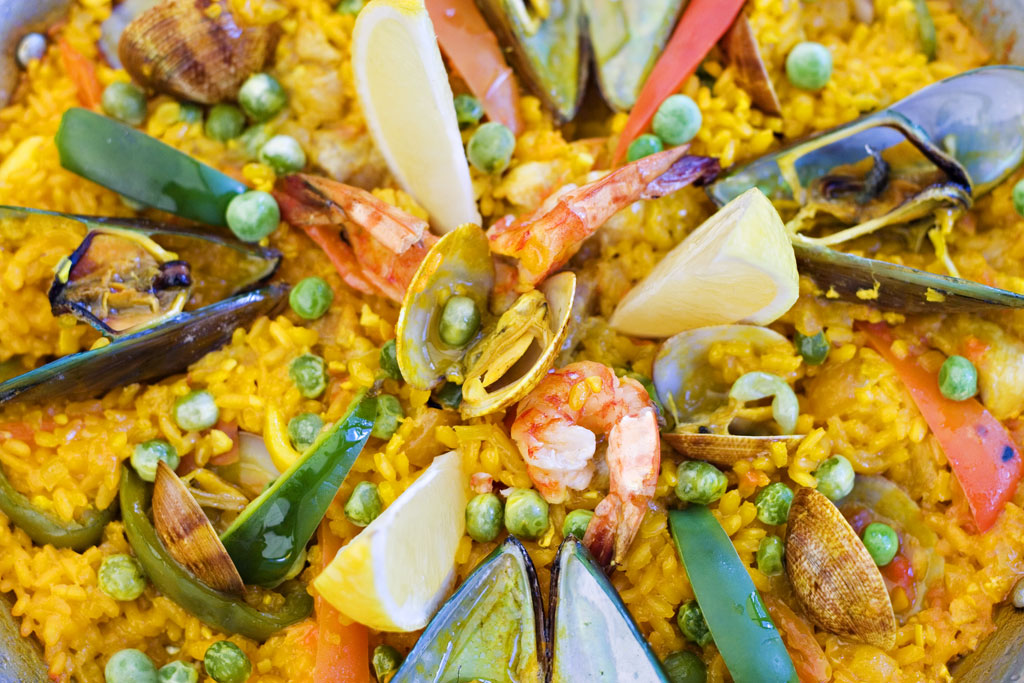
Paella de Marisco
As in every rice dish, the type and quality of the chose rice greatly effect the dish. Asian rice such as Basmati will not do for paella. In Spain arroz bomba is sold specifically for paella and will absorb the liquid without getting mushy, but as it is difficult to find in the States, I often substitute the Arborio rice used for risotto.
While it is preferable to prepare your own caldo, or stock, any quality broth will do.
If you don't want to run out and buy a paellera, a large cast iron skillet works great and is perfect for cooking outside on the grill. Avoid using a non-stick pan as you want the rice to form the flavorful crust called socarrat. Many Spaniards swear its the best part of the paella - you can express love by offering your share of the crust to your loved one.
1 lb mejillones (mussels), cleaned 
1/2 lb camarónes (prawns), traditionally with heads on
1/2 lb calamares (cuttlefish or squid) 
1/4 lb pulpo (octopus)
6 cloves garlic, chopped
1 medium onion, chopped
1 Piri Piri pepper, chopped
1 cup grated tomatoes
2 C rice
~4 C fish stock
Few strains of saffron, soaked in 2 T water
1 C dry white wine
Lemon pieces for serving
Bring the stock to a boil then turn down to a simmer.
Prepare the sofritto: Fry the garlic, pepper, onions and chile. Add the tomato and stir. Add the rice and let it stick to the bottom of the pan for a few seconds as it hisses or "sings." Add the wine and absorb. Add the stock, saffron and let simmer 10 min. You may need to add more water or scrap occasionally, but let the rice form some crust at the bottom of the pan. Add the seafood, tucking into the rice and cook ~15 min. until the rice is cooked al dente. Photo: Flickr benjieordonez


HEY! We've seen that cuisine before! Cook the foods of today's competing countries using other recipes: try Portuguese/Brazilian Feijoada with a Korean spin on Cote d'Ivoire's traditional plantains or Korean-spiced Portuguese hens and Honduran Tres Leches Cake with Spanish poached pears. If you didn't get a chance to try our Spanish Fondue with a Chilean Carmenere and Honduran dessert, you must go back to what has been one of our favorite meals of the tournament. As we get deeper into the tournament, it's time to bring out the leftovers, mix & match, and let the fusion menus run wild like a frenzied North Korean defense.

Prefer to eat out instead? Our Dining Guide tells you where and why.


Spicy World Pure Spanish Saffron 2 grams - Fresh!


Spanish Saffron Acrylic Box (3 pack)


Paella Seasoning Sachets with Saffron


June 21, 2010

6/21: Portugal v North Korea, Chile v Switzerland, Spain v Honduras

We spice up a traditional Portuguese grilled chicken today with gochujang, a thick hot sauce that forms the flavor basis for many Korean dishes. 
A deep, red paste, gochujang is made from chili powder, fermented soybeans and other seasonings such as rice, sweet potato or honey. You can find it at your local Korean market or order online. A common dinner in Portugal, this grilled chicken is basically a dish of foul glazed with a spicy sauce. You can use a roasting chicken or even chicken breasts, but we chose to use cornish hens for their rich flavors.
Asado is popular in Chile, where it is usually accompanied by pebre, a spicier equivalent of the Argentinean Chimichurri and represented in today's dish by the Korean gochujang. The dish would go phonomanally well with any number of Chilean Cabs in honor of today's Chile vs. Switzerland game. 
To represent Switzerland, chose a wine with the most neutral flavors you can find.
Korean Spiced Frango Piri Piri

1 T sea salt
4 cloves garlic, halved
1 T sweet paprika
2 T finely chopped cilantro or parsley
1/4 tsp pepper
1/4 C red wine vinegar
~3/4 C olive oil as needed
1 roasting chicken or 4 small cornish hens
Use a mortar and pestle to crush the garlic with the salt into a paste. Add paprika, parsley and pepper. Drizzle in the vinegar and then add oil to make a mushy, spreadable paste. Stir in the gochujang.
Butterfly the hens and coat generously with seasoning. You will have left over paste to use for basting. Place skin side up on a hot grill and grill, basting generously, for ~15 min. Turn over and repeat. The birds are done when they reach 165 F.  Photo: Flickr: kattebelletje

Ample Tres Leches left over from last Wednesday's Honduras vs. Chile match, we're representing Honduras once again today with their most widely known national dessert. To accompany our Tres Leches and honor Spain, we're also poaching a few spicy pears.
Peras al vino
3 pears, pealed and cored
1/2 C sugar
1 cinnamon stick (add more if your sticks are not fresh)
1 C dry Spanish red wine
1 C water
Whisk together the sugar, wine, water and cinnamon stick in a saucepan. Bring to a boil and add the pairs. Turn down to low and simmer until pears are soft and have absorbed most of the liquid.
Slice the pairs and arrange atop the Tres Leches for a beautiful plate, or serve a pair whole on the plate with a side of cake.

HEY! We've seen that cuisine before! 
Cook the foods of today's competing countries using other recipes: Feijoada from Portugal, Korean BBQ Ribs or Kimchi or Spanish Fondue! As we get deeper into the tournament, it's time to bring out the leftovers, mix and match, and let the fusion menus run wild like a frenzied North Korean defense.
Prefer to eat out instead? Our Dining Guide tells you where and why.


June 15, 2010

6/15: New Zealand v Slovakia, Cote d'Ivorie v Portugal, N. Korea v Brazil

Dilemmas, dilemmas. After searching endlessly for a Pavlova in a Houston restaurant to represent New Zealand in our World Cup Dining Guide, I realized that most people don't actually know what a Pavlova is! This gorgeous meringue and whipped cream fruit tower named after the famed Russian ballerina has somehow fallen off our culinary radar. I've been looking forward to making it ever since.
Unfortunately, New Zealand is playing on the same day as Portugal, my favorite country for baked goods. What to do? Create a menu of just desserts? 
Even better, Portugal and Brazil playing on the same day provides a unique opportunity to address two national cuisines in a single dish!
It's also quite handy that modern Portuguese cuisine is heavily influenced by the cultures of its former African colonies and vice versa, so the Ivory Coast and Portugal compliment each other well. Feijoada, a stew of beans and pork is a typical Portuguese dish, although far more well-renowned is the Brazilian version where the Fava beans are replaced with black ones. Here we combine the traditional Feijoadas of Portugal and Brazil with the quintessential Ivoirian snack of fried plantains.
Comprised of over 60 unique ethnic groups, the Ivory Coast has varying regional cuisines, but is united by common cash crops that are remnants French rule. A the leading producer of cocoa and third largest producer of coffee, you may wonder why I did not choose an Ivoirian dish based on these staples. I never buy cacao or coffee from West Africa, which has not only destroyed much of the region's rainforest but employs one of the largest child and slave labor forces in the world. So here's my plug: buy fair trade cacao and coffee! Although it would have been ironic if we'd paired Ivoirian slave cacao with North Korean flavors. But no irony can justify the horrendous flavor profile of such a dish!
Instead, the pungent sweetness of the plantains should compliment North Korean kimchi, as it is known to be of a softer, less garlicky flavor than its southern counterpart. North Korean cuisine is known for its cleaner, milder tastes. Kimchi, the most well-known of all Korean foods, is a pickled vegatable dish served as a banchan (side dish) in countless variations in nearly every Korean meal. It will serve us well here since we can spice up the same kimchi later and call it South Korean. Never fear, the only thing totalitarian about this dish is that it's totally tasty :) 

Feijoada with kimchi-plantain banchan

Feijoada
1/2 lb dried fava or great northern beans, soaked overnight and drained
1/2 lb black beans, soaked overnight and drained
1/2 lb bacon
1/2 lb carne seca (spicy dried beef)
1 large onion, chopped
4 cloves garlic, minced
Bay leaf
3/4 lb chourico/linguica, cut into 1/4-inch slices
1 dried red chili
Chicken stock/broth
In a large pot, cook bacon until it starts to crisp. Add chourico and cook until lightly browned. Add onions and cook until golden, then add bay leaf, garlic and chili. Add remaining ingredients, adding the broth gradually to desired texture. Salt and pepper to taste. Remove the bay leaf and chili.
Photo: 1.bp.blogspot.com

Banchan: Pyongyang style kimchi; fried plantains
As kimchi must pickle over the course of a few days, we're picking ours up at the local Korean grocery. However, I've posted a recipe so as to explain what is involved in making kimchi at home
1/4 C coarse sea salt
1 head Napa cabbage, cut into small wedges
3 cloves garlic
1 in piece of ginger root
2 T Asian Fish Sauce
1 Asian radish, peeled and grated
1 small bunch green onions cut into 1-in pieces
1 T Korean chili powder
Dissolve the salt in a 1/2 gal container. Mince the garlic and ginger or combine in food processor with the fish sauce (once again, I call on my immersion blender). Combine the radish, onions and garlic mixture in a bowl with the chili powder. After squeezing and patting as much water as possible out of the cabbage, stuff the leaves with the radish mixture and stuff into the brine. Let sit for 2 to 3 days.

To prepare the fried plantains, simply slice two ripe (blackened) plantains and fry ~3 min until golden. Ivoirian plantains are typically fried in palm oil since olive oil is too expensive, which you are welcome to try, but I would not recommend it for health or flavor reasons. Toss the plantains with kimchi and serve in the closest thing you can find to a cute little banchan dish.

New Zealand vs. Slovakia
The Pavlova is said to have originated in the 1920's during one of the dancer's visits to New Zealand. More than just a meringue, the Pavlova is low baked, leaving a soft inner texture and traditional decoration with exotic fruits such as passionfruit and kiwi. In honor of its origins, we've decided to go with kiwis.
In order to create a Slovak element to our Pavlova, we've served it atop a traditional Slovakian pastry colorfully named "Bubbly cake." Slovakia seems to have taken the spicier, tastier end of the Czech republic split in the culinary department and offers some tantalizing dishes. I hope to revisit the Country later on in the tournament. Their desserts are typically built around some sort of pancake or coffee cake and topped with a fruit sauce such as blueberries. The name, "Bublanina" dervies from its bubbling batter during baking. Yes, Bublanina's batter bubbles during baking - say it three times fast! We've adapted the recipe to include less sugar so as to better compliment the Pavlova topping and left the blueberry sauce for final serving atop the meringue. Also, TX blueberries are in season.
Dances with Bublanina
Prepare the Bublanina:
1/2 cup (1 stick) butter, softened
1/2 cup sugar
3 large eggs divided, at room temperature
1 tablespoon Grand Marnier or other orange liqueur (optional)
1 teaspoon orange zest
1/2 teaspoon salt
Pinch of cream of tartar
1 cup all-purpose flour
2 cups fresh blueberries, washed and stemmed
Place rack in center of oven and heat to 350 degrees. Butter or lightly coat with cooking spray a 9-inch-by-9-inch baking pan. In a medium bowl, cream together butter, sugar and yolks until light and fluffy. Add liqueur, if using, orange zest and salt, mixing well. In a clean medium bowl, beat egg whites with cream of tartar until stiff. Alternately fold in egg whites and flour into butter-egg mixture. Turn batter into prepared pan and scatter blueberries evenly over top. Press down into batter with a spatula. Bake 30 to 40 minutes or until toothpick inserted near center comes out clean. Cut into 6 equal pieces.

Prepare the Pavlova:
4 egg whites at room temperature
1 C of Castor sugar
1 tsp white vinegar
1/2 T cornstarch
1/2 tsp vanilla 
1/2 C cream
Fresh kiwis, sliced
1 T fresh lemon juice
Preheat the oven to 275F. Line a baking tray with foil and draw a 7 inch circle on the foil (don't tear the foil). Set aside.
In a clean, medium-sized metal bowl, beat the egg whites with a clean electric mixer on medium speed. Beat until the whites form soft peaks. Gently sprinkle the sugar into the egg whites, until your egg whites form glossy stiff peaks.
Sprinkle the cornstarch and vinegar on the meringue and fold in gently with a plastic spatula. Add the vanilla and gently fold the mixture again.
Now gently spread the meringue in the circle on the foil to make a circular base. Make sure the edges of the meringue are slightly higher then the center so you have a very slight well in the middle.
Bake the meringue ~1:15 or until it goes a very pale, pinkish color.
Turn the oven off and leave the door slightly ajar to let the meringue cool completely. As the meringue cools, it will crack slightly.

Blueberry Sauce
1 pints fresh blueberries, washed and stemmed
1 tsp fresh lemon juice
2 T sugar
Reduce berries in a saucepan until sauce is desired consistency.

To assemble the Dances with Bublanina:
Arrange the Bublanina on a cake plate and top with the meringue.
Whip the cream with the vanilla extract until it forms peaks and gently spread the cream to the top of the meringue with a spatula. Arrange kiwis on top and drizzle blueberry sauce to serve.

Prefer to eat out instead? Our Houston Dining Guide tells you where and why.