Showing posts with label Netherlands. Show all posts

July 13, 2010

7/12: THE FINAL: Spain v Netherlands

Olé, olé, olé, olé!!! THE DAY HAS ARRIVED! It is amazing how quickly one month of feasting, drinking and excitement can pass. As you know, we've been pulling hard for Spain to take this year's Cup all along and we're sure that they will - after all, the Octopus has spoken (and rest assured, you won't find any octopus on our menu in his honor, despite their prevalence in Spanish cooking).
Our celebratory menu, which we plan on preparing just as soon as the massive hangover fades, highlights the Spanish conquest by taking over Dutch cuisine with Spanish flavors. Here at World Cup Food Challenge, Spain conquers on the pitch and in the kitchen!

Erwtensoep, also called snert, is a pea soup once referred to as the "glory of Dutch cuisine." It is traditionally made a day ahead to give the flavors time to steep together and served with a thick slab of kielbasa (smoked sausage).  We guarantee that the world's best Dutch pea soup would fail to stand up against Caldo Gallego, the traditional soup of Galicia where foul peas are replaced with garbanzo beans (think hummus) and kielbasa replaced with glorious chorizo. Celery, eternally one of the most hated foods globally, is left out altogether. We do agree with the Dutch on thing, though - this soup is even better the next day.
Spain conquers Snert: Caldo Gallego Erwtensoep
1/2 pound thickly sliced pancetta, chopped
1 cup dried white beans, soaked overnight in water and drained
1 large onion, diced
2 potatoes, peeled and diced
2 turnips, peeled and cut into 1/2 inch dice
1/2 lb Spanish chorizo, sliced thinly
1 lb dark leafy green such as Broccoli di Rabe or mustard greens
Cook the pancetta in a large heavy pot over medium heat until most of the fat is rendered. Add the beans to the pot, cover in water and bring to a boil. Turn the heat and simmer, partially covered, ~45 min until softened. Add the onions, potatoes, and turnips and cook for 20 minutes, or until the vegetables are softened. Add the chorizo and greens and cook for 10 minutes, or until the greens are tender.

Hete Bliksem literally means "hot lightning" in Dutch, despite its lack of hot or lightning. Plus one, however, for the fun name. A tart yet smokey take on mashed potatoes, it is typically served alongside Gehaktballen, or Dutch meatballs, one of the best loved dishes of Nordic cuisine. If you must try traditional Dutch versions, we recommend the recipe over at Kayotic Kitchen, where Kay blogs live from Gouda (and lucky for her, she's not much of a football fan - allowing us to plug her recipe without disdain).
Due to the Arabic and North African influences, meatballs are common throughout Spain, especially in Andalucia where they are served in tavernas, steaming in the cazuela alongside a tall glass of Cruzcampo. While recipes for Dutch meatballs call for a pinch of nutmeg and mustard to flavor the beef, the Andalucian version spices up rich lamb with cumin, paprika and a saffron-almond sauce.

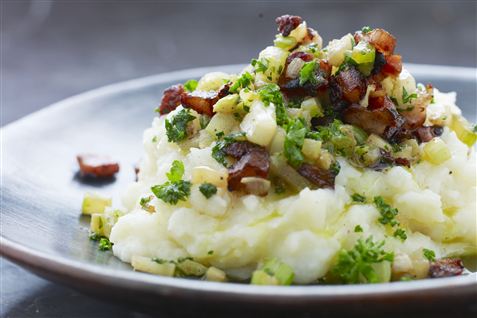
Hete Bliksem simmers a slab of bacon in water and then uses this water to boil the potatoes, adding flavor. The potatoes are then mashed with the chopped bacon and sautéed apples. Our Spanish version uses a cansalada to flavor the potatoes and substitues tangly Cabrales for the tart apples. The addition of milk and ample butter create a creamy, indulgent purée where once was a pile of Dutch starch. Cansalada, a form of salted pork fat back is used abundantly in Catalan home cooking and you will be hard pressed to find potatoes that do not feature its delightfully fatty flavors. Any pork fatback will do and our recipe calls for a ham hock, more commonly found in American kitchens. Puré de Patatas (mashed potatoes) flavored with this fat are called Trinxat in Catalan.
Spain conquers Hete Bliksem: Relámpagos calientes (Hot Lightning in Spanish)

1/2 lb ham hock
3 shallots, diced but not finely
2 1/2 lb potatoes, peeled and diced
5 tablespoons unsalted butter
3/4 cup hot milk
1/4 lb Cabrales (Asturian blue cheese similar to Gorgonzola)

Brown the ham hock in oil at the bottom of a large stock pot. Add the shallots and sauté until soft. Add the potatoes, cover with water and boil the potatoes gently until tender, ~20 min. Drain off about half the water and then use a potato masher or hand mixer to purée. Beat in the butter and milk until thick and creamy. Stir in the Cabrales and season with salt and pepper.

Spain conquers Gehaktballen: Albóndigas Andalucia
2 lb Ground lamb
1/2 md Onion, minced
2 Garlic cloves, minced
1 tsp cumin
1/4 tsp Pimenton (Spanish paprika)
1 T minced parsley
1/2 tsp lemon juice
1 Egg
1/2 c Flour
For the sauce:
1 lg Spanish onion, chopped
6 T Spanish olive oil
1 1/2 C beef stock
1/4 C Blanched almonds
1/4 tsp Saffron threads
3 Garlic cloves
1 T parsley
Combine the lamb through lemon juice and sprinkle liberally with salt and pepper. Add the egg and mix well. Form into 1-in balls, dust with flour and refrigerate at least 10 min. Heat oil in a frying pan until just smoking. Add meatballs and cook until they begin to brown. Add the onion and cook until golden. Add stock and let simmer 15 min.
Pulse almonds, saffron, garlic and parsley in a food processor or spice grinder until a fine powder. Stir into the meatballs and serve immediately alongside the potatoes.


First made in Gouda in the 18th C, Stroopwafel are layered caramel wafers, legendary in the Netherlands with a rich Dutch history. Today, we give them a new, better tasting history - a Spanish one. The batter is fairly similar to an American waffle and the filling is a simple boiled sugar syrup and butter. If they make it to the Cup in 2014 we'll expect they'll discover better things whilst in Brazil and will come home with Dulce de Leche and Guayaba filled Stroopwafel, or say forget it altogether and just eat alfajores.
As Stroopwafel are typically eaten as a snack, rather then a dessert, we've put our version in as a cheese course that can be served as an appetizer or before dessert. If you've experienced cruise ship or country club fine dining, you're familiar with dainty Parmesan tuiles. I've always loved these, no matter how overdone, and am happy to conquer the Dutch by preparing them with a Spanish cheese. 
Garrotxa, a nutty sheep's milk cheese from Cataluña, presents the walnut flavors of aged Reggiano, the crispness of Champagne and the freshness of young grass in a single cheese.  You can also use Mahon, one of the few cow's milk cheeses of Spain, which has a butter and intense tangy flavor to it, but it is a crumbly cheese whose texture proposes a challenge to this particular dessert. It's flavors, however, wildly compliment fig. If you'd like to experiment, Cheese From Spain presents a wealth of facts and flavor profiles in astonishingly bad organization sure to suck you in, frustrate and delight.

A specialty of Andalucia, Pan de Higo was created to preserve figs for the winter. It not only travels well, looks lovely and pairs divinley with a variety of wines and cheeses, but it is possibly the easiest dish to make in the world - no cooking involved. I would argue that Pan de Higo probably yields the greatest impressive to effort ratio in the history of food. 
Spain conquers Stroopwafel: Garrotxa 'Wafel' de Higo

Prepare the 'Pan' de Higo:
1/2 lb dried figs, stems removed and chopped
1/4 C Marcona almonds, toasted
¼ tsp ground cloves
2 T sesame seeds
½ tsp anise seeds
1 orange, zest and juice
Cinnamon, to taste
1 T honey
Brandy (optional)
Pulse the almonds in a food processor until chopped but not fine. Repeat with the figs. Mix the almonds, figs, cloves and seeds together. Add the zest and juice of the orange to taste. Add cinnamon to taste. Add just enough honey to make a thick, but spreadable paste. If moisture is needed, add brandy or more orange juice.
Prepare the Garrotxa 'Wafel':
6 T Garrotxa, finely grated
Sprinkle 1 T cheese on a nonstick skillet over medium-high heat. When the cheese starts to bubble, remove and press down on a plate into a thin disc shape. Prepare the other 5 tuiles.
Assemble the Stroopwafel:
Glaze a Garrotxa wafer with the fig mixture (it will be easier to spread if warmed) and top with another wafer.

Griesmeelpudding is an old and rather traditional Dutch dessert that boils coarse, semolina flour into a sweet porridge. It is often served with raisins and sprinkled with cinnamon. While boiled porridge puddings sound fine and British, a custard of sweet rice milk infused with real cinnamon and orange essence wins any day. You may leave out the raisins, as many prefer, but growing up my Grandma always included raisins and I swear by them! Prevelant throughout Latin America, these versions of rice pudding thicken with evaporated milk rather than egg and cream since these ingredients were not widely available. If you've enjoyed these versions, the original Spanish recipe will delight you as the texture is far silkier and simply, heavenly.
Spain conquers Griesmeelpudding: Arroz Con Leche
3 T brandy
1/2 C sultana raisins
1 C long-grain white rice
2 cinnamon sticks
1 lemon or orange
1/2 gallon (fresh) whole milk
1/2 cup raw honey 
1/2 cup cream
3 eggs
1/4 teaspoon sea salt
ground cinnamon to taste
Soak the raisins in brandy overnight. Remove the zest (the colored, not white portion of the rind) from the lemon or orange (I like them both and mix it up or use whatever is on hand). Soak the rice, zest, and cinnamon in water for at least 1 hr, preferably overnight. Add the milk and honey to the rice and simmer for ~30 min, making sure to stir the rice so it does not stick.
Whisk together the cream, eggs, juice and salt. Remove the cinnamon sticks and add the egg cream to the rice. Cook over low heat until thick. Stir in the raisins and sprinkle with cinnamon to serve. 

July 6, 2010

7/6: Uruguay v Netherlands

This is sure to be an incredible game as the last Latin American country standing puts up a fight against what looks to be an all-European final. Our hearty feast, a celebration of all things fried, will keep you well nourished through all the fist pounding and jumping that this game is sure to inspire.
Holland fans can stock up on all things Dutch over at Typical Dutch Stuff, which sells everything from wooden clogs to frozen snacks. They are having a particularly large run on kroketten and bitterballen for the Cup games, so we presume these are the most popular game day snacks in The Netherlands. Thus, we've included recipes for both of those today but you can always order them frozen. Hup Holland Hup!
Luckily for us, they also offer a Recipe blog where you can delve further into the exciting world of Dutch cuisine beyond the Gouda. 


Dutch Chivito with Bitterballen/Kroketten 
Chivito, the Uruguayan national dish, appears a simple sandwich at first glance but is so much more! The dish was invented accidentally in a 1950's Punta del Este tourist restaurant for a woman who asked to eat chivito (goat in Spanish) and was served this sandwich instead by a kitchen that had apparently seen a run on baby goat. Typically prepared with think slices of churrasco and ham or bacon, our Dutch spin puts Kroketten in the mix for the beef.
Essentially the same as Bitterballen, a Kroket comes in a oblong shape rather than the traditional round ball. They are often served at cocktail parties or as a snack with a pre-dinner drink. Seldom made at home, Kroketten (the Dutch spin on the French croquette), are a typical bar snack, served alongside french fries like a Dutch Fish and Chips.
Mustard is entrenched in Dutch heritage and they take great pride in flavorful, artisan mustards made with whole mustard seed. Simply put, the yellow squeeze bottle will not cut it here.
Photo: Niclas on Picasa
Prepare the Kroketten:
½ lb ground beef
1 small onion, chopped
1 bay leaf
2 eggs, separated
2 T butter 
3 T flour
1 tsp lemon juice
Bread crumbs
Simmer meat with salt, onion, and bay leaf in 1 ½ cups of water until meat is well done ~1 hour. Drain off the liquid and bring to a simmer in a saucepan. Add butter and then flour, cooking until thickened. Remove from heat, add lemon juice and season with salt, pepper and a pinch of curry powder. Beat the yolks and add to the stock mixture. Pour over the meat. Chill until firm ~2 hours. Form into oblong meatballs, roll in bread crumbs, dip in whisked egg white and then fry in hot oil. Serve with Dutch mustard.
Assemble the Dutch Chivito:
Lightly coat two pieces of bread with Dutch mustard. Top with fresh mozzarella and toast slightly to melt. Add a few slices of thickly cut, freshly fried ham and then the freshly fried Kroketten. Top with a fried egg, and lettuce and tomato if you like. The key word here is really fried.


HEY! We've seen that cuisine before! Cook the foods of today's competing countries using other recipes: try our Slovak/Chilean take on the Dutch Uitsmijter breakfast or try our Danish, 'Burning Love,' take on the traditional Dutch Stamppot.  The taste of Uruguay first grazed our World Cup Food palletes during the second game of the Cup as they won against France and won us over with an incredible Dulce de Leche Crème Brulée and came to pair, coincidentally once again with French flavors during our Latino conquest of duck confit with confit ravioli.

Prefer to eat out instead? Our Dining Guide tells you where and why.

7/2-3: Quarter Finals Feast

As we move into the final round, we're changing things up a bit and preparing pan-country feast to celebrate each final. You can choose which game to prepare the entire feast for, or just munch on a single dish for each game. We plan on celebrating a Spanish win by cooking up the entire array of dishes on Saturday.
Our theme for the Quarter Finals Feast? Street Food!
The Netherlands v Brazil
All that cycling and harsh weather make for a hungry people, who snack all day and still find the stomach for a hearty dinner. Often overlooked on the culinary scene, the cosmopolitan city of Amsterdam offers a diverse array of street food from the Indonesian stalls to the ubiquitous pancake houses. The Dutch are passionate about their french fries and a heaping cone of frites can be purchased on nearly every street corner. Vleminckx is renowned for frying up the best selection, serving them with onions, frietsaus (essentially mayonnaise) or a peanut sauce called "oorlog," which is Dutch for war - see, I told you they were serious about their fries! Our version serves them alongside an exotic Brazilian hot sauce. 

Brazilian street vendors offer all the usual hot dogs and hamburgers alongside regional specialties such as Pão de queijo (similar to the Paraguayan Chipa), salgadinhos (savory pastries), Iced Mate and queijo coalho grilled cheese kababs in Rio, and acarajé (black eyed pea fritters) and cocada (coconut candies) in Bahia. Whatever you buy, if it is savory, it is sure to come with Molho de Malagueta hot sauce. Known as "grains of paradise," malagueta peppers were one of the original exotic spices that lead Portuguese explorers to discover Brazil. A close relative of the serrano, these peppers are dangerously spicy. If you can't find the peppers, you can order the sauce from Rio's of Austin
Molho de Malagueta
1/4 cup palm oil
1 C vinegar
1 small yellow onion, chopped
7 malagueta peppers
1 tsp. fresh ginger, grated
1 tsp. salt
Heat the oil over low heat in a small skillet. Add the onion and sautee until it's translucent, about 5 minutes. Add the peppers, stir and cook until they are very mushy, about 15 minutes. Add the ginger and cook for another minute. Add the salt and stir. 
Belgian Frites
3-4 C frying oil
2 lbs Idaho/Gold/baking potatoes, peeled and sliced into 1/4 in wide sticks
The streets of Amsterdam sell authentic Belgian-style frites, characterized by a crunchiness achieved only through skill and double frying. The first time they are fried, they are cooked until tender. The second time, often done hours later, they are transformed into golden and deliciously crisp frites.
Heat the oil to 325°F. Divide the potato sticks into batches of 1 C each. Fry 4-5 min. per batch until lightly colored but not browned. At this point the fries can rest for several hours at room temperature until you are ready to serve. Repeat the frying process and then salt to taste. 
Serve with Molho de Malagueta. If it is too spicy, try whisking some into mayonnaise for an authentic Dutch Frites experience. 


Uruguay v Ghana
Uruguay street food includes the usual South American options of hot dogs piled high with every imaginable topping for less than a $1,  endless varieties of empanadas and churros, along with regional favorites such as chivitos, milanesas and tortas fritas (fried biscuits). 
Street food in Ghana is available from travelling pedestrian vendors, stalls, and ubiquitous "chop bars". Traditional African dishes, such as fufu, kenkey, banku, fried yams, and bushmeat kebabs are popular across the country while regional varieties use local ingredients such as fresh seafood along the coastline and fried cheese in Northern. Kenkey are steamed balls of fermented corn dough that come wrapped in corn husks or banana leaves. The dough is allowed to ferment for several days to take on sour flavors. If that doesn't appeal to you, and I can see why it may not, we'll go ahead and just eat ours fresh sans-sour. Classic accompaniments for kenkey include seasoned fried fish ( kyenam) or a fresh hot pepper sauce. Our menu uses kenkey as a base for Uruguay's best loved dish, Chivito. 
Ghanian Chivitos
Prepare the kenkey:
3 C fine corn flour
1 T corn starch
2 1/2 C warm water
Corn husks
Knead the dough until smooth. Then prepare the "aflata," which is a part of the dough cooked with water and added to the uncooked dough. Mix 2 C water with 1 tsp salt and half the dough, then cook over medium heat 10 min, stirring constantly. Remove from heat and stir in the uncooked dough. Form the dough into balls and wrap each ball in corn husks. Steam for 1 hour.
Assemble the Chivitos:
Tope each kenkey with a slice of thin grilled steak or ham, pancetta, mozzarella and a fried egg. 


Argentina v Germany
Germany has a number of Turkish street foods beyond the pan-European shawarma. Döner is similar to shawarma and available everywhere, especially in Berlin. Bavarian Fleischkäse, similar to meatloaf, is generally served with sweet mustard in a roll. Germany, known for its various types of sausage, lines its streets with ample wursts and beer is sold at all sidewalk snack stands.
In Argentina, vendors sell Choripán, a barbequeued sausage wrapped in french bread, or morcipan, the blood sausage (morcilla) version. Street empanadas are usually fried and can be made with beef, fish, ham & cheese or neapolitan. Other local street food includes local versions of the hotdog called pancho, tostados and lomitos. Sweets found in Argentine streets include caramel apple (manzana acaramelada), sweet popcorn (pochoclo) and a local snack called Garrapiñada, made of peanuts, cocoa, vanilla and caramel.
German Choripán
The Argentine choripán consists of a sausage made out of beef and pork, hot off the grill, split down the middle (called mariposa), and served on a roll. 
First, prepare the Chimichurri using our recipe from the game against Nigeria way back in June. Then, chose your wurst. As in Bratwurst, Currywurst or other variety of German sausage. Slice a baguette down the middle, spread each side with Chimichurri and insert the grilled German sausage. 


Paraguay v Spain
Our culinary journey through Paraguay as they've advanced in the Tournament has showcased many of their most popular street foods of sopa, chipa and milanesa. We even took a look at maté during an early Argentina game. In Paraguay, the local infusion of yerba mate is called Tereré and it is served cold, often with herbs such as lemongrass or fruit juices. Workers have a "tereré break" instead of a coffee break. 
Street vendors are uncommon in Spain as snacks are provided by hole in the wall tavernas selling a variety of traditional tapas. In the bigger cities, fast food bocadillo (sandwich) and North African kebab joints can be spotted on many side streets. During ferias and other events, however, the vendors come out of the woodwork hawking everything from ice creams to legs of ham. By far the most predominant street food, the staple of Spanish late night eats, is the churro. While you may have experienced versions filled with dulce de leche or pastry cream throughout Latin America, the notorious fried pastries originated in Spain, where they are dipped in a thick, bitter hot chocolate, most often as club goers head home around sunrise.
In place of the traditional chocolate, we serve our churros with tereré de chocolate. The Republic of Tea sells a Double Dark Chocolate Maté that is fairly easy to find, or you can make your own by stirring dark cocoa powder into maté.

Churros
1 C water
2 T brown sugar
1/2 tsp salt
1/3 C butter
1 C AP Flour
2 eggs
1/2 tsp vanilla
1/4 C sugar
1 tsp cinnamon
Bring water, brown sugar, salt and butter to a boil. Remove from heat and stir in the flour. Add the eggs and vanilla.
Heat ~2 in. of oil in a frying pan or deep fryer to 375F.
Fill a pastry bag with the dough, using a star shaped decorator's tool. In Spain, churros are piped using a churrera, a cookie-press looking contraption with the start nozzle. You can buy one, use a cookie press or a simple pastry bag. The star shape is the key to provide the right look and crunchy texture.
Test your oil to make sure it is hot enough by piping a small amount of dough into it. If the dough bubbles up right away, the oil is hot. One at a time, squeeze a line of dough into the oil. Squeeze out as many as your fryer will hold and cook ~5 min. until golden, turning as needed. Drain excess grease and sprinkle with cinnamon sugar.


HEY! We've seen that cuisine before! Cook the foods of today's competing countries using other recipes: From The Netherlands we enjoyed a Stampot of Burning Love and a Dutch Uitsmijter sandwich. Brazil delighted our taste buds with FeijoadaCaipirinhas and passion fruit mousseUruguay found its way on the menu several times since opening day, twice fused with France in Dulce de Leche Crème Brulée and Duck Confi Ravioli. It was the clear winner over Ghana's Jollof rice, although a Ghanian spin on German Black Forest Cake took on one of this year's toughest teams with fury. Less exciting from Germany was their cucumber salad, Gurkensalat, spin on the English tea sandwich, but the Käsespätzle German take on mac 'n cheese will surely grace our kitchens again. Both are severely overshadowed by Argentina's contributions of ChimichurriMalbecDuck confit empanadas and especially, alfajores. If they can stand up equally well on the field we'll be impressed and surprised! Paraguay, with its hearty reflections of Argentina and indigenous cultures, never failed to please with dishes such as Sopa Paragauaychipa, and the fried deliciousness of the Milanesa. Unfortunately for them, their up against intense competition. Spain's cuisine of Manchego and ChorizoPeras al VinoPaellaAjo Blanco and Gambas al Ajillo clearly comes out on top, so much so that we devoted an entire post to discussing their cuisine

Prefer to eat out instead? Our Dining Guide tells you where and why.

June 28, 2010

6/28: Netherlands v Slovakia, Brazil v Chile


Feeling as though I've exhausted the existing selection of traditional Slovak dishes that appeal to me, I'm happy to bid fairwell to the team as we proceed into the next round. Chile, on the other hand, is a country I wish I'd spent more time on. I recommend the recipes at Canela Kitchen, which posts straight from the source in Santiago, Chile. Her recipes include a variety of empanadas and puddings, which come in endless creative flavors in Chile such as corn and prawn, and are listed in both English and Spanish. We're posting two Chilean recipes today to bid adieu and cannot encourage you enough to take this opportunity to enjoy an awesome Carmenere.
Slovaks are shocked when they arrive in the US to find people pouring syrup and whipped cream on their French Toast - they eat it salty! Dutch Uitsmijter is a hearty open-faced sandwich of ham, eggs and cheese, often served for breakfast. Uitsmijter' means 'bouncer' in Dutch, telling the story of a late night snack served just before getting kicked out of the bar. I can think of few foods more perfect for a World Cup match.
If they aren't already serving it on French Toast, they certainly will be now. 
I sincerely doubt we'll ever see the Dutch slathering a cilantro salsa upon their Uitsmijters, but for those of us in places like Texas where breakfast doesn't count if it's not served with salsa, a traditional Chilean Pebre ties this dish together perfectly. Similar but in many ways superior to pico de gallo, pebre is served on everything from grilled meat to sandwiches.  If you cannot find aji chiles, a jalepeno will do, but firey flavors are not characteristic of Chilean cuisine. 
Uitsmijter on Chlieb vo vajci (Dutch sandwich on Slovak French Toast)
Whisk 3 eggs (vajcia), salt liberally, and coat bread (chlieb) in the egg (typically, rye bread is used) then fry on a hot greased pan.
For the Uitsmijter:
Top the Chileb slices with ham and Gouda. Fry 2 eggs, sunny side up, then top the bread. Add Pebre to taste.

Chilean Pebre
1 onion chopped finely
1  green ají chopped
1 tablespoon of oil
1 tablespoon of cilantro chopped
1 tablespoon of lemon juice
Combine in a food processor - consistency should be chunky.
Chile v Brazil
An elegant red wine meringue traditionally served with crema inglesa, or clotted cream, this is the equivalent of a Chilean zabaglione. Brazilians are also fond of meringue and use it in almost every popular dessert from banana pie to the layered pavê desserts
They also prepare a red wine pudding called Sagu de vinho whose flavors may be reminiscent in this turron, although certainly not the textures. Taking inspiration from the Italian pairing of zabaglione and fruit, we pair the Turrón with the national dessert of Brazil- a simple yet heavenly passion fruit mouse. The combination of egg whites and condensed milk-based desserts calls on two cultural legacies that characterize modern Latin American cuisine - the legacy of the monks and the Nestlé market penetration that brought its canned milks to the South before fresh milk become widely distributed. Today, Brazilians still call Nestlé the "Leite Moça" or milkmaid.
Turrón de vino con Mousse de Maracujá
Prepare the Mousse:
1 C creme de leite (Brazilian evaporated milk) or cream
1 C sweetened-condensed milk
1/2 C frozen passion fruit or juice if you cannot find the pulp
(optional) one fresh passion fruit
Pureé in a blender until fluffy then chill for a few hours.

Prepare the Turrón:
1/2 C Chilean red merlot or cabernet
3/4 C sugar
3 egg whites
1 cinnamon stick
pinch of salt
In a pot heat the red wine with the cinnamon stick and sugar ~8 minutes until a heavy syrup. Remove cinnamon.
Beat egg whites with pinch of salt until soft peaks, then slowly drizzle in the wine syrup while beating the whites until meringue is cool.
To serve: Divide the chilled mousse into glasses and top with a dollop of turrón.


HEY! We've seen that cuisine before! Cook the foods of today's competing countries using our other recipes: Enjoy a Danish/Dutch Stampot of Burning Love along with Slovak goulash and bryndzové halušky. Slovakia's Bublanina is a clear winner, though we doubt they'll prove so successful in the game as opposed to the kitchen.


Brazil has dominated our menus when compared to Chile, as it will likely dominate the game. It would be difficult for anything to stand up to Feijoada and Caipirinhas


although the Chilean seafood included in our Paella provides ample competition.


Prefer to eat out instead? Our Dining Guide tells you where and why.

Elimination Round

On to the Round of 16! Stepping into the elimination stage, we take a look at the foods of those countries that have made the cut:


Uruguay found its way on the menu several times since opening day, twice fused with France in Dulce de Leche Crème Brulée and Duck Confi Ravioli. They'll face South Korea on Saturday, a country we've seen in spicy and distinctly Asian short ribs.


Later on Saturday, the US faces Ghana in an unexpected match. Ghana may compete on the pitch, but in the World Cup of Food, USA is a clear winner with Bacon Brownie Cupcakes and Texas Peach Pie over Ghana's Jollof rice. However, a Ghanian spin on German Black Forest Cake may be one of the 2010 WCFC's crowning achievements.

Later on in the weekend, England will face a formidable opponent in Germany in what is sure to be a violent match between the two rivals. While it may be World War on the pitch, Käsespätzle, or German mac 'n cheese, made a great addition to our English Ploughman's Lunch, albeit with an Algerian twist.
Earl Grey Ice Cream, however, would be an unlikely topping for our bananas Ghana take on German Black Forest Cake.

Argentina versus Mexico presents a great opportunity for exploring two complimentary, but unique and exciting cuisines. While Argentina will always hold a special place in our hearts for blessing us with Chimichurri and Malbec, we'd find it tough to live without tacos, margaritas and Arroz Mexicana. They both win when filled with Duck confit in the form of empanadas and tamales, and while, sure, its all fun and games when we're all beat France, but only one will walk off the pitch a winner after Sunday's game.

Come Monday, The Netherlands will play Slovakia to remind us just how tired we are of Gouda and dishes that end in "-sky." Nevertheless, we did enjoy both naming and eating the Danish/Dutch Stampot of Burning Love along with Slovak goulash and bryndzové halušky. The clear winner here is Slovakia's Bublanina, though we doubt they'll prove so successful in the game as opposed to the kitchen.

Brazil has dominated our menus when compared to Chile, as it will likely dominate during Monday's game. It would be difficult for anything to stand up to Feijoada and Caipirinhas
although the Chilean seafood included in our Paella provides ample competition.

Regardless of what happens during Japan v Paraguay, the game and cuisine are sure to take backstage to the Iberian feast we have planned for Spain v Portugal. You're likely to have noticed by now through my single inclusion of Japan in a dipping sauce that this is a cuisine that has never quite been able to interest me. Paraguay, on the other hand, with its hearty reflections of Argentina and indigenous cultures, I find enticing. Dishes such as Sopa Paragauay, with the slight deviation of adding my homegrown green chile, and the fried deliciousness of the Milanesa make this landlocked Latin American country the clear winner in this match. My bets are on them for the game as well.

Portugal, the land of my beloved porto; the country that gave birth to Feijoada and spiced up Mediterranean dishes with Piri Piri has much to be proud of, but will forever take backstage to its larger neighbor to the east. Spain, more beloved to me even than porto for its Rioja, brings Manchego and Chorizo as well as Peras al Vino to the table. While they may win on the basis of these dishes alone, traditional Paella clearly puts them on top, so much so that we devoted an entire post to discussing their cuisine.


June 24, 2010

6/24: Paraguay v New Zealand, Slovakia v Italy, Cameroon v Netherlands, Denmark v Japan


Known as the single most defining dish of Slovak cuisine, Halušky are translated as potato dumplings, but are really more of a cross between gnocchi, spätzle and polenta. Much like the Slovak culture itself, the dish blends flavors from its various borders. Though topped with just about anything, and over 30 varieties dominate menus at Slovak cafés, the most common addition is bryndza, a farmer's sheep cheese, and bacon. The combination produces the national dish of bryndzové halušky.
Preparation is nearly identical to gnocchi, but in the final stages more water is added and the dumplings are cooked into more of a polenta-like texture, particularly once the cheese is added. This makes for a very Italian but distinctly Slovak dish.
We substitute ricotta salata for the Slovak farmer's cheese, bryndza, but any Italian sheep's cheese will lend similar flavors to the dish. While the texture of ricotta is preferable, pecorino shavings could also be delicious. I'm thinking of trying this again with a peppered pecorino. One of Italy's oldest cheeses, pecorino's origins go back to the legend of a shepherd that filled his flask with sheep's milk for a long trip and the milk accidentally fermented during his travels. If you can't find either of these cheeses, or they prove to be too expensive, which they often are, try making your own ricotta.
Due to the central role of potatoes in Danish cooking (you remember the "Jeg er en heldig kartoffel!" from Stamppot of Burning Love?) and their own version of potato dumplings, we're going to consider our dish representative of Denmark as well.
In place of the bacon, we're adding a Paraguayan touch to our Halušky by topping it with a Milanesa, a bread and fried meat, not unlike the southern chicken fried steak but much improved upon it. If you find you become a fan of the Milanesa, join the club - there's even a Facebook group!
Paraguay and New Zealand are strangely alike in culinary heritage. In Paraguay, historic influences of the Guarani culture blend with European settlers and in New Zealand, the Māori indigenous influence modern cuisine and distinguish the island from the Aussies. By far the most representative of the Maori's role in cooking are the traditional hāngi preparations that involve slow roasting meats on heated stones in a covered pit. In an ideal world, we'd roast a pig in the hāngi and use that meat to prepare our Milanesa. If you dare to try it, we'd love to see the pictures!
Halušky a la Italia y Paraguay
Prepare the Halušky:
2 large potatoes
5 T flour
1 egg
3 tsp salt
Peel two large potatoes and shred finely. Add egg, flour and 1 tsp salt. Knead into a soft dough, adding flour or water if necessary.
Bring a large pot of salted water to a boil. Cut the dough into small pieces and boil until the dumplings float.
Photo: Flickr: mylifeisyummy

Prepare the Milanesa:
3 thin cuts of beef steak or veal chops
Juice of 1 lime
1 egg
2 garlic cloves, minced
2 T olive oil
2 C fresh bread crumbs
Soak the meat in lime juice, and gently pound into 1/8 in thickness. Pat dry and season with salt and pepper.
Beat egg with garlic, oil and salt. Coat the beef with the egg wash and then cover with breadcrumbs. Fry in hot oil until a golden color.
Assemble the dish: Scoop the Halušky out of the water using a slotted spoon. Stir in the ricotta and top with Milanesa.


HEY! We've seen that cuisine before! Cook the foods of today's competing countries using other recipes: try Slovakian Goulash on Sopa Paraguay and a New Zealand take on the Italian classic Zabaglione or Dances with Bublanina, our Slovakian twist on the most famous dessert from down under: the Pavlova. An unusual preparation of yuca as Cameroonian Couscous with a Japanese dipping sauce turned out to be a favorite, as did our Burning Love take on a Dutch Stamppot. As we get deeper into the tournament, it's time to bring out the leftovers, mix & match, and let the fusion menus run wild like a frenzied North Korean defense.

Prefer to eat out instead? Our Dining Guide tells you where and why.


June 18, 2010

6/19: Ghana vs. Australia, Cameroon vs. Denmark, Netherlands v Japan

Ghana and Cameroon are represented today by leftovers of two national dishes: Jollof rice and Fufu. We're serving these alongside an exciting Australian recipe that took some serious researching to achieve. Yes, we found kangaroo meat. And we're throwing it on the barbie.
Since Kangaroo is an extremely low fat, high protein meat (you've seen how they jump!) it must be cooked carefully to retain some moisture. We soak our kangaroo fillets in oil for a few minutes before searing on a hot cast iron pan. Carefully salted and peppered, we also opted to slightly bread the 'roos so as to further retain moisture and add flavor.

To further develop the essence of Australia, above and beyond eating adorable marsupials, we've included this handy video.

A few recipes that caught my eye, courtesy of the Kangaroo Industry itself:
Carpaccio of Kangaroo with Chutney
500 gm Kangaroo Fillets
200ml Virgin Olive Oil
120ml Red Wine Vinegar
100g Melon Chutney
Chill Kangaroo fillets and slice as thin as possible – place on a chilled plate with the chutney. Drizzle the red wine vinegar and olive oil over the kangaroo slices and serve.
'Roo Mash
250g Kangaroo Back Loin
1 Sweet Potato
1 Potato (large)
3 Baby Onions (roasted in the oven)
200ml Beef Jus (fancy name for beef stock - Ed)
1 tablespoon Bush Tomato Chutney
1 Parsnip
50g Butter
Make a mashed potato with both the sweet potato and normal potato with butter and seasoning. Place beef jus, chutney and baby onions in a pan and reduce until thick. Peel parsnip and shave into thin slices and deep fry. Sear the kangaroo.
Place mashed potato in the middle of a large flat plate. Place the seared kangaroo on mashed potato facing inwards. Pour chutney jus over the kangaroo. Put roasted baby onions around the meat and place parsnip crisps on top to serve.
Wallaby Bolognese
Finely chop 1 onion and 1 apple and fry together until transparent. Add 500gm wallaby mince, salt pepper, pinch of nutmeg (to taste), 400gm tomato puree, 1/2 cup red wine. Simmer for 20-30 minutes. Serve with 1 pkt cooked spaghetti. Serves 6-8.

The Netherlands vs. Japan
It's Saturday, we have a house full of food and we're taking the day off from this game. Do Heineken sake bombs if you dare.


Until tomorrow, happy kangaroo grilling.

Can't fry that sweet kangaroo face and prefer to eat out instead?
Our Houston dining guide tells you where and why.


June 14, 2010

6/14: Netherlands v Denmark, Cameroon v Japan

I'm rather enthused at how easy today's menu came together, despite the daunting cuisines that represent today's match countries. Completely unfamiliar with the foods of any of these countries, save for my experiences with restaurant sushi, I was elated when my research revealed a few obvious ways in which their national dishes would compliment one another.
Since the old-fashioned Dutch dinner consists of one simple course, usually involving a large portion of potatoes, this seemed an easy place to start. The mashed potatoes, when mixed with some vegetables or meat, are called a stamppot, a word I am rather fond of. However, I'm not nearly as fond of stamppot as I am of the traditional Danish dish, Burning Love, or Brændende Kærlighed (though I still prefer the South African trainsmash). The Danish, as it turns out, are also quite fond of potatoes. To provide an example of the exalted status of the potato in Danish culture, one has only to look at the popular saying, "Jeg er en heldig kartoffel!" (I am a lucky potato!). 

This dish, essentially extra fattening mashed potatoes, seems to be the Danish equivelant of a stamppot. Since I felt it needed a bit more Dutch-isizing, I decided to melt some gouda on top, turning it into an almost Shepherd's Pie like dish (let's hope they play England so I can do it again!) The most renowned Dutch food by all means, is Gouda, which can be spiced up with the flavors of clove, cumin, caraway, or nettles. 
While integrating the cuisines of West Africa and Japan initially posed a challenge, I quickly found a popular Cameroonian dish that would go great with a Japanese sauce! Fufu, a dumpling made from pounded starch such as yam or yuca (cassava), is a staple dish throughout West Africa. In Cameroon, the fufu is called couscous by the French-speaking peoples and typically made from yuca. While the dish is traditionally prepared by pounding the cassava into a paste with a giant mortar and pestle, a food processor can also be used. I'm opting for my immersion blender, which I'll make sure to take whenever I hit up West Africa.
In general, the Cameroonian diet is characterized by bland, starchy foods that are eaten with spicy (often very hot) sauces, so we're pretty sure they would love the addition of wasabi! Throughout Latin America, yucu is served boiled with a spicy garlic sauce or chimichurri, so the addition of wasabi is sure to be delicious! 

Stamppot of Burning Love on Danish Rye
fufu Pictures, Images and Photos
Photo: media.avisen.dk
1 head of garlic, roasted and peeled
1 T olive oil
6 floury (Idaho) potatoes
10 strips bacon
1 red onion, finely chopped
1 C milk, 1% milk buttermilk
2 T butter, room temperature
~1/4 lb Gouda or other Dutch cheese
Danish Rye

Peel the potatoes and cut into quarters, then boil ~30 min. until tender. As the potatoes cook, cut bacon into small pieces and fry with chopped onion until bacon is crisp and onions are soft. Drain potatoes well and pat lightly with paper towels to dry. Mash the potatoes and combine with roasted garlic cloves, milk, and butter until smooth and creamy (a stand mixer with a whisk attachment is great for this). Spoon the potatoes into a bowl and top with the bacon and onion mixture. Grate desired amount of Gouda or Dutch cheese of choice and give it a few seconds in the microwave to melt.
Serve with or piled high on a slice of Danish rye bread.

Cameroonian Couscous À la Japonaise 
2  lbs (~4 large) yuca root
1 oz. Japanese wasabi
Soy sauce

Boil the roots for ~25 min. until soft and the skins cut easily. Drain the roots and peel thoroughly. The peel can be toxic, so take care in this step. Using a potato masher or hand mixer, mash the roots until completely smooth. Shape into tightly formed balls.
To prepare the sauce, mix a tiny amount of wasabi into a dish of soy sauce. Serve alongside the Couscous balls for dipping. Cameroonians prefer to pour their sauce of choice on the Couscous, but we've decided to serve the dish Japanese style - separate with a small dipping plate.

*Note: Real Wasabi is a rootthat is highly perishable and extremely pricey. If you're lucky, you can find it in powder form at a Japanese grocery for a reasonable price. Most of us will have to settle for the Americanized version, which is essentially just horseradish dyed green. It's still delicious and presents the flavor most of us are familiar with when eating sushi.


Prefer to eat out instead? Our Houston Dining Guide tells you where and why.